How Far Apart Should You Hang Pictures on a Wall?
Last Updated: November 4, 2026
Quick Summary
Leave 2 to 3 inches between frames in a tight grouping, and 3 to 6 inches when you hang pictures as separate pieces on the same wall. That gap is the breathing room that lets each piece be seen.
- Measure 6 to 8 inches up from the sofa back, not down from the ceiling.
- Cut paper templates the same size as each frame and tape them up before drilling.
- Keep gaps consistent at 2 to 3 inches even when frame sizes vary.
- Use wider gaps of 4 to 6 inches on brick and stone walls.
- Add about an inch to planned gaps under side lighting.
Table of Contents
- The Simple Rule for How Far Apart to Hang Pictures
- How High to Hang Art Above a Sofa
- How to Arrange Multiple Pictures on a Wall
- The Best Tools for Hanging Pictures (and Testing Your Layout First)
- When Your Walls, Frames, or Lighting Change the Math
- Planning Your Wall Around a Piece You Love
- Frequently Asked Questions
The Simple Rule for How Far Apart to Hang Pictures
The short answer: leave 2 to 3 inches between frames in a tight grouping, and 3 to 6 inches when pictures hang as separate pieces on the same wall. That gap is the breathing room that lets each piece be seen.
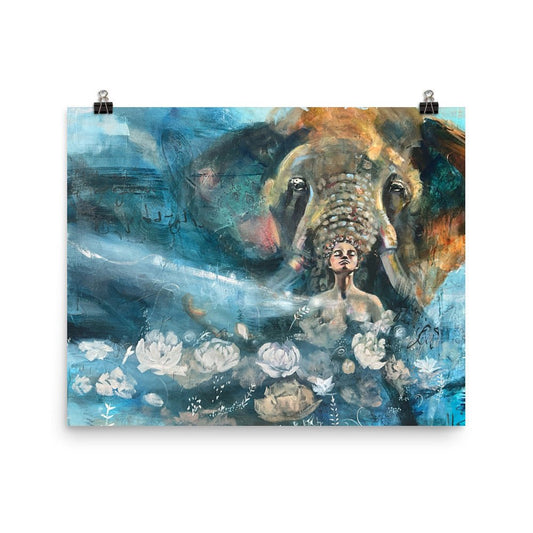
I'm Sarah Andreas, and I make layered paintings. How far apart to hang pictures is a question that comes up often when people are deciding where a piece should go.
Here's the part most guides skip. The space between frames does as much work as the art. Too tight, and a wall feels crowded.
The Smithsonian's guidance on hanging and caring for art makes a similar point: arrangement should serve the artwork, not the other way around.
Why the Space Between Matters as Much as the Art
Think of the gap as negative space. In a painting, the empty areas let color and texture settle. On a wall, the empty areas do the same job.
A few things the gap controls:
One common mistake is treating the gap as leftover space. It isn't. It's part of the composition.
Here are the key spacing numbers I come back to again and again.
| Situation | Spacing | Note |
|---|---|---|
| Tight grouping | 2 to 3 inches between frames | Keeps pieces reading as one group |
| Separate pieces on same wall | 3 to 6 inches | Gives each piece breathing room |
| Art above a sofa | 6 to 8 inches above sofa back | Measure up from the sofa, not the floor |
| Grid layout | Consistent 2 to 3 inch gaps | Calm and formal |
| Mixed frame sizes | Keep gaps consistent, not frames | 2 to 3 inches between every piece |
| Plaster walls | Slightly wider, 3 to 4 inches | Room to adjust if a hole needs repair |
| Brick and stone | Wider gaps of 4 to 6 inches | Uneven surface, frames sit at different depths |
| Under side lighting | Add about an inch to planned gaps | Shadows make tight spacing look tighter |
How High to Hang Art Above a Sofa
The standard is 6 to 8 inches above the sofa back. That distance ties the art to the furniture below it, so the two feel like one arrangement instead of two separate things.
Most people hang too high. A high nail feels safe, but art floating near the ceiling loses its connection to the room.
Measuring From the Sofa, Not the Floor
Measure up from the top of the sofa, not down from the ceiling. Sofa backs vary in height, and the floor tells you nothing about where the furniture actually sits.
- Measure the sofa back height.
- Add 6 to 8 inches.
- Mark that point on the wall.
- Center the frame on the sofa, not the wall.
How to Arrange Multiple Pictures on a Wall
Start by cutting paper templates the same size as each frame. Tape them to the wall and live with the arrangement for a day before you pick up a drill.

Paper costs nothing and saves nail holes, so it is a practical way to plan a wall before you commit.
Find the Center Point First
Every arrangement needs one anchor before anything else goes up. For a single piece, the center of the frame is often placed near eye level, and for a grouping that same height can serve as the center line the arrangement hangs around.
Measure the width of your wall space, mark the midpoint, and use that as your starting reference. If the furniture below is off center, center on the furniture instead, since it gives the eye a reference point a bare wall does not.
Build the Layout Around One Largest Piece
A gallery wall holds together when one piece leads. Place the largest frame first, usually slightly above or below the center line rather than dead on it, then arrange the smaller pieces around it.
- Grid: same size frames in even rows and columns, with consistent 2 to 3 inch gaps. Calm and formal.
- Salon style: mixed sizes filling a defined rectangle, edges aligned to an invisible border. Feels collected over time.
- Center line: all pieces share a horizontal midpoint, with sizes varying above and below. Good for hallways and above furniture.
How to Space Different Frame Sizes
When frames vary in size, keep the gaps consistent rather than the frames. A 2 to 3 inch gap between every piece, regardless of size, is what makes a mixed grouping read as one composition.
A useful check: stand back about 6 to 8 feet and squint. If one gap looks noticeably wider than the others, it will bother you later. Small frames need slightly more air, so if a tiny piece feels crowded, give it an extra inch rather than shrinking every gap.
Balance Visual Weight, Not Just Size
A small dark frame can carry as much weight as a large pale one.
Find Art That Speaks to You. →
This is the same decision making that happens inside a painting, where a small area of deep color can hold its own against a large soft field.
If you're planning a larger grouping, it helps to see large framed fine art prints arranged together before you commit to a layout.
The Best Tools for Hanging Pictures (and Testing Your Layout First)
You need four things: a tape measure, a level, painter's tape, and a drill. Add a pencil and a stud finder, and you can hang almost anything safely.
- Painter's tape for marking the center point and frame edges
- A level for checking each frame, not just the first one
- A stud finder for anything heavy
When Your Walls, Frames, or Lighting Change the Math
The 2 to 6 inch rule assumes a smooth wall and even light. Change either one, and the spacing needs a second look.
Wall Material Changes What You Can Hang and How Tightly
Drywall is the easiest surface. A stud finder locates the framing, and a hollow wall anchor handles most frames.
Plaster is harder and often crumbles around a nail.
Brick and stone need masonry anchors and a masonry bit.
Paneling and shiplap have grooves that can throw off a level.
Watch out: guessing at hardware for a heavy frame is the mistake that costs people a wall repair.
Lighting Decides How Wide the Gaps Should Read
Light changes how a gap looks, not just how it functions. A ceiling fixture directly above a grouping flattens the shadows and makes tight spacing look fine. A lamp casting light from the side creates shadows between frames, which makes tight spacing look tighter and can make a careful layout feel crowded.
- Under side lighting, add about an inch to your planned gaps.
- In a dim hallway, wider gaps keep pieces from blurring together.
- If a sconce sits between two frames, center the gap on the sconce so the light reads as part of the arrangement.
A Simple Formula for Nonstandard Walls
When a wall is an unusual width or you are working with a fixed number of frames, the 3 to 6 inch rule can leave you with awkward leftover space. Try this instead.
- Measure the total wall width you want the grouping to fill.
- Add up the widths of all frames.
- Subtract the frame total from the wall width.
- Divide that number by the number of gaps (one more than the number of frames in a row).
If the result lands between 2 and 6 inches, you have a workable layout. If it comes out under 2 inches, remove a frame or split the grouping into two rows. If it comes out over 6 inches, add a piece or narrow the wall span.
If your space is limited, these ways to display art in a small apartment can help you work with the walls you have.
Planning Your Wall Around a Piece You Love
Sometimes the art comes first and the wall plan follows. That's my favorite way to do it.
Start with the piece's scale. A large painting can anchor a wall alone. A smaller work often wants company, which means planning the gaps around it from the beginning.
I'm glad to help with this part. You can also read what collectors say about living with the work before you decide.
Frequently Asked Questions
What is the standard spacing for a gallery wall?
Most gallery walls look best with 2 to 3 inches between frames. That gap keeps the grouping reading as one piece rather than a scatter of unrelated pictures. If your frames are large, you can go a little wider; small frames look better closer together. The real test is stepping back: if the gaps pull your eye apart instead of letting it travel, tighten them up.
Does the size of the frame change how far apart I should hang pictures?
Yes. Larger frames can carry more space between them without the grouping falling apart, while small frames need tighter spacing to feel connected. A useful habit is to keep the gaps consistent within one grouping, even when the frame sizes differ. Consistent spacing does more for a cohesive look than any single measurement.
How can I test my layout before putting holes in the wall?
Cut paper templates to the size of each frame and tape them to the wall with painter's tape. Move them around until the spacing and height feel right, then mark the hanging points on the paper. This lets you check how far apart to hang pictures, and how high, without committing to a single hole. It also helps you see how the arrangement sits next to furniture and in different light.
Where should I avoid hanging a picture?
Skip spots with steady direct sun, which fades both prints and original work over time, and steamy areas like right over a shower. Avoid hanging pieces where a door swings or where furniture regularly bumps the wall. In rooms with strong heat or moisture swings, give the frame a little breathing room from the wall so air can move behind it.
Choosing where art goes is really a series of small decisions about what you want to see every day. If you're ready to find a piece that fits the wall you're planning, I'd love for you to explore my available paintings and prints. Each one is made with layers of color and texture, and I'm happy to help you think through scale and placement so it feels right in your space.